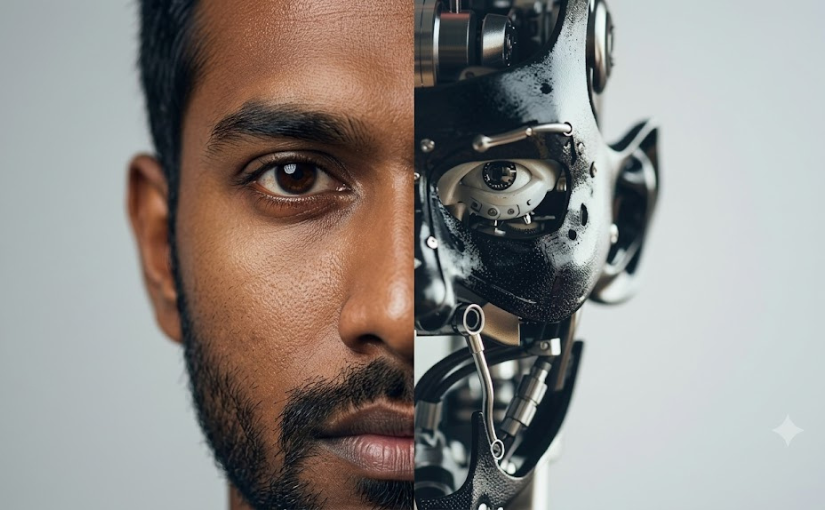
A cyborg is a being that is part biological and part mechanical or electronic. The term was originally coined to describe humans enhanced with technology.
Today, in a way, we have all become a type of cyborg.
Without technology, most of us would accomplish only a fraction of what we do today.
As technology has advanced, the amount of work a single person can accomplish has increased dramatically.
So, in a world like this, how should we evaluate the talent of candidates during recruitment?
Should we measure only their raw talent? Or should we measure what they can achieve with modern digital tools?
Raw Talent
Raw talent is a person’s processing power.
It includes their ability to understand new concepts quickly, think logically, solve problems, learn rapidly, exercise good judgment, and communicate effectively.
These are the underlying abilities that remain valuable regardless of which tools are available.
Talent with Digital Tools
Talent with digital tools is a person’s real-world productivity.
It measures how effectively they use Google, AI, documentation, IDEs, design tools, automation, and other technologies. It reflects how quickly they can produce high-quality work and how well they combine multiple tools into an efficient workflow.
Assessing Only One Side
Some interviewers try to eliminate every digital aid.
They ask candidates to write algorithms on a whiteboard, remember obscure syntax, or solve problems they would normally Google in 30 seconds.
While this reveals certain aspects of raw ability, it often ignores how people actually work.
There is the opposite mistake too.
Candidates are allowed to use AI for everything, and interviewers never discover whether the candidate truly understands the solution. The candidate may simply be copying AI-generated answers without being able to verify, adapt, or troubleshoot them.
Neither approach gives the full picture.
Performance = Raw Ability × Tool Effectiveness
The strongest employees usually have:
- Solid fundamentals.
- Good judgment.
- Excellent use of modern tools.
Someone with exceptional raw talent but poor tool usage may not be very productive.
Likewise, someone who only knows how to prompt AI, but lacks fundamental understanding, will eventually hit a ceiling because they cannot verify, adjust or troubleshoot the AI’s output.
What Should You Test in an Interview?
A better approach is to split the assessment into two parts.
1 – Fundamentals (No AI)
Evaluate the candidate’s:
- Logical reasoning.
- Understanding of core concepts.
- Ability to explain how something works.
- Ability to debug a simple problem.
- Ability to discuss trade-offs and justify decisions.
2 – Practical Task (AI Allowed)
Give candidates a realistic work assignment.
Observe:
- How they use AI.
- Why they accept or reject AI suggestions.
- Whether they verify AI-generated answers.
- The quality of the final result, not just the speed.
This reflects how they will actually perform on the job.
Weighting Must Be Changed to the Role
The balance between raw ability and tool usage should vary depending on the role.
Junior engineers should be evaluated more on raw ability and learning potential. AI skills can be learned quickly, but strong fundamentals take years to develop.
Mid-level engineers should demonstrate both solid technical foundations and effective use of modern tools.
Senior engineers, architects, and project managers should be evaluated more heavily on judgment, decision-making, communication, system thinking, and their ability to use technology to increase the productivity of themselves and their teams.
The Shift of the Evaluation
As AI becomes a standard part of professional work, hiring solely based on raw memory and intelligence is becoming less predictive of success.
At the same time, hiring solely based on AI-assisted output is risky too.
The candidates who consistently perform best are those with strong fundamentals who know how to amplify their abilities with modern tools.

A multifaceted professional known for diverse interests and contributions in various fields, including management, technology, education and entrepreneurship. Also the founder of ITPro.lk, bringing a unique perspective and industry knowledge to writing.