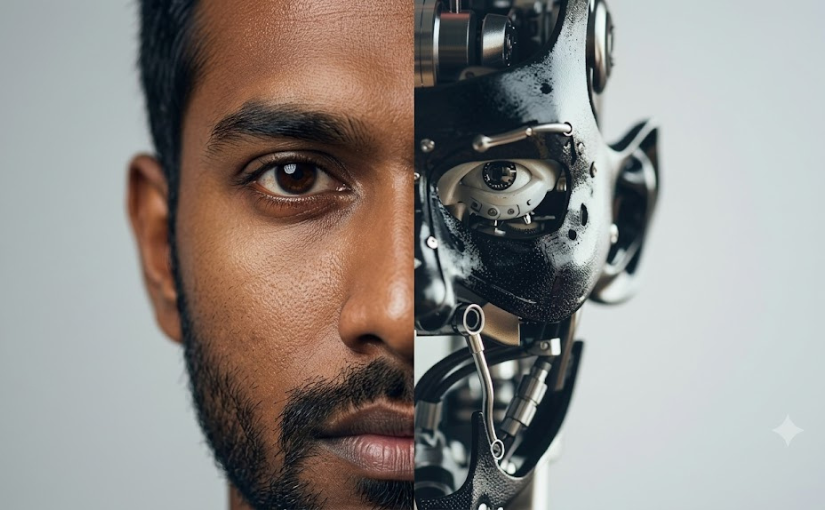
AI vs IT Outsourcing: Threat or Opportunity?

AI has moved beyond experimentation and into real business impact. Every day, we hear news about rapid advancements by major AI companies, traditional business systems being transformed with AI, and workforce reductions driven by automation.

Amid all this noise, it has become increasingly difficult to clearly understand how AI is truly impacting our industries, especially IT service outsourcing.

Like any major technological shift, the core goal of AI is automation. This naturally changes the demand for manual labor and reshapes how work is done. Sri Lanka’s IT industry, which is heavily driven by service-based outsourcing, is particularly affected by this disruption.

Threats

Reduced demand for low level outsourcing

Routine tasks such as helpdesk support, basic coding, software testing, and data entry are increasingly automated by AI-powered tools. This reduces the need for large teams handling repetitive tasks, directly threatening traditional outsourcing models.

Diminishes cost arbitrage advantage

Outsourcing has traditionally relied on lower labor costs in offshore locations. As AI replaces human effort, the cost advantage of offshore services becomes less significant.

Increased competition

Small and mid-sized companies in high-cost countries can now use AI to perform tasks they previously outsourced. This shift may shrink the overall outsourcing market.

Client expectation shift

Clients may expect higher efficiency and more value at lower prices, as AI promises cost savings. This creates additional pressure on outsourcing vendors to deliver more for less.

Opportunities

Enhanced service delivery

Service providers can integrate AI into their offerings such as intelligent monitoring, predictive maintenance, AI-powered customer support, and AI-assisted coding.

These enhancements make services more efficient, scalable, and valuable.

New revenue streams

There is growing demand for AI strategy, integration, training, and ongoing support. Companies with AI expertise can offer new services such as model deployment, data engineering, AI governance, and compliance solutions.

Efficient workforce

Organizations can operate with smaller, highly skilled teams that use AI as a productivity multiplier. This improves margins and enables companies to move up the value chain from “labor providers” to “strategic partners.”

Focus on complex human centric work

Skills such as creativity, critical thinking, problem-solving, client relationships, and high-level system design are difficult to automate. Outsourcing companies can reposition their workforce toward these areas while allowing AI to handle repetitive tasks. This shift emphasizes experienced professionals over low-cost labor.

Small, expert, veteran” teams will be the future

Predicting the exact impact of AI is difficult, but it is clear that both risks and opportunities lie ahead for the outsourcing industry.

Shrinking the workforce size is a clear sign and already happening. How our industry embrace this change?

Companies must rethink their workforce strategies favoring smaller, expert, veteran teams over large workforces focused on mundane tasks. For those willing to adapt, AI presents a massive opportunity to deliver smarter, faster, and higher-value services, ultimately moving them up on the value chain.

5 Modern Interview Questions for Software Engineers in the Age of AI

Assessing technical skills is never easy. A technical interview is useful not only because it tests coding ability, but also because it reveals how someone thinks, communicates, and approaches problems. That’s something you don’t always get from a written test or assignment.

Traditionally, interviews focused on algorithm puzzles, syntax, and textbook system design. But in today’s world, where tools like GitHub Copilot and ChatGPT can generate code instantly. What matters now is how engineers use these tools wisely, review what’s produced, and make sound decisions.

Here are some types of interview questions that matter more in the age of AI:

1. Code Review

Q: If an AI assistant generated this code snippet, how would you check whether it’s safe, correct, and efficient?

A strong answer should include testing edge cases, checking for security issues, and making sure the code is clear and maintainable, and not just trusting the AI output blindly.

2. Debugging AI-Generated Code

Q: Here’s a function that works but is failing in one edge case. Walk me through how you’d debug it and identify the issue.

This shows how the candidate reasons through a problem, not just whether they can fix it.

3. AI in System Design

Q: Design a job recommendation system that uses an AI model. How do you handle cases where the AI gives irrelevant or biased suggestions?

Good answers mention fallback logic, monitoring, feedback loops, and awareness of fairness and bias.

4. Prompt Engineering / Problem Framing

Q: Imagine you need an AI to generate boilerplate code for a REST API. What would your first prompt look like, and how would you refine it if the output wasn’t good enough?

This tests whether the candidate can clearly frame problems and work with AI as a collaborator.

5. Critical Thinking Beyond AI

Q: An AI tool suggests a clever one-line solution, but it’s hard to read. Do you keep it or rewrite it? Why?

A thoughtful answer should focus on maintainability and clarity, knowing that humans will maintain the code.

Reverse Engineering and Critical Thinking Matter

These questions go beyond memorizing algorithms and simple coding drills. They’re about how candidates think, adapt, and make decisions in a world where AI can generate code instantly. They highlight skills AI can’t replace: reviewing and reverse engineering AI outputs, debugging edge cases, framing problems clearly, handling bias responsibly, and prioritizing readability over shortcuts.

Boilerplate may be automated, but judgment, problem deconstruction, and collaboration remain uniquely human, and that’s what modern interviews should uncover.

ITPro AI Surpasses 20,000 Job Application Ratings – Is AI Recruitment Just a Fad?

Originally posted on Medium, can read it here: Go to Medium article

The social media post posted in January

In January this year, we introduced ITPro Ratings, a feature that automatically scores each job application submitted through our platform. Since then, the number of rated applications has grown steadily alongside the rising popularity of ITPro.lk. We’ve now crossed an exciting milestone of over 20,000 applications rated by our AI.

How Does ITPro Ratings Work?

Recruiters can view a list of applicants and their CVs directly from their dashboard. Each application is given a rating out of 10, automatically generated by our AI. This score is calculated by comparing the content of the candidate’s CV with the job advertisement. In addition to this number, it gives recruiters an AI-powered insight into how well an application matches the advertised role.

Real Benefits?

ITPro is a high-visibility marketplace for tech job ads in Sri Lanka. A single job post can attract hundreds of applications. If you’re a busy recruiter receiving, say, 500 CVs for a single role, manually reviewing each one may not be realistic. ITPro Ratings allows you to sort applications by relevance, helping you focus first on the ones that are most aligned with your requirements.

That said, ITPro Ratings does not attempt to evaluate candidate competency or technical skills. Skill evaluation is a nuanced and context-specific challenge that cannot be fully solved with a one-size-fits-all solution.

This raises a valid question: Is it justifiable to shortlist candidates based purely on the language used in their CVs? Let us know your thoughts in the comments!

Human Judgment Comes First

Recruitment is fundamentally a human process built on relationships and context. Automation can help, but only to a point. That’s why we’ve designed ITPro Ratings to support, not replace, human decisions.

We understand that job seekers worry their applications might be rejected without ever being seen by a human. On ITPro.lk, applications are always presented to recruiters in chronological order, and the system never discards or auto-filters any applications. The rating is simply an additional insight, not a decision-making tool.

What the Data Says

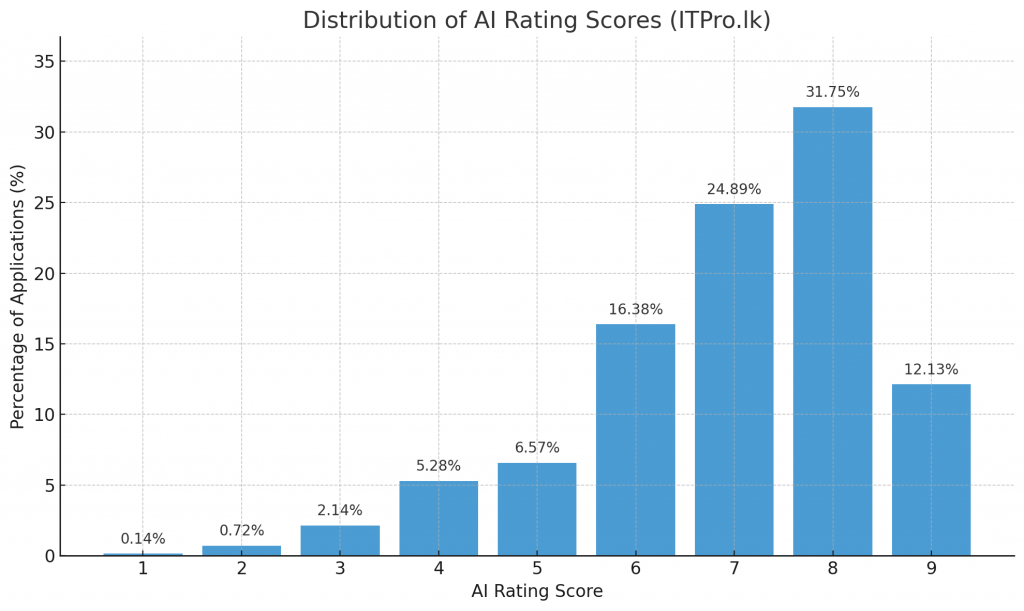
Here is the chart showing the percentage distribution of AI rating scores. You can clearly see that most applications received a rating between 6 and 8, with 8 being the most common score. The internet already has plenty of CV guides, templates, and services, which has helped to raise this standard.

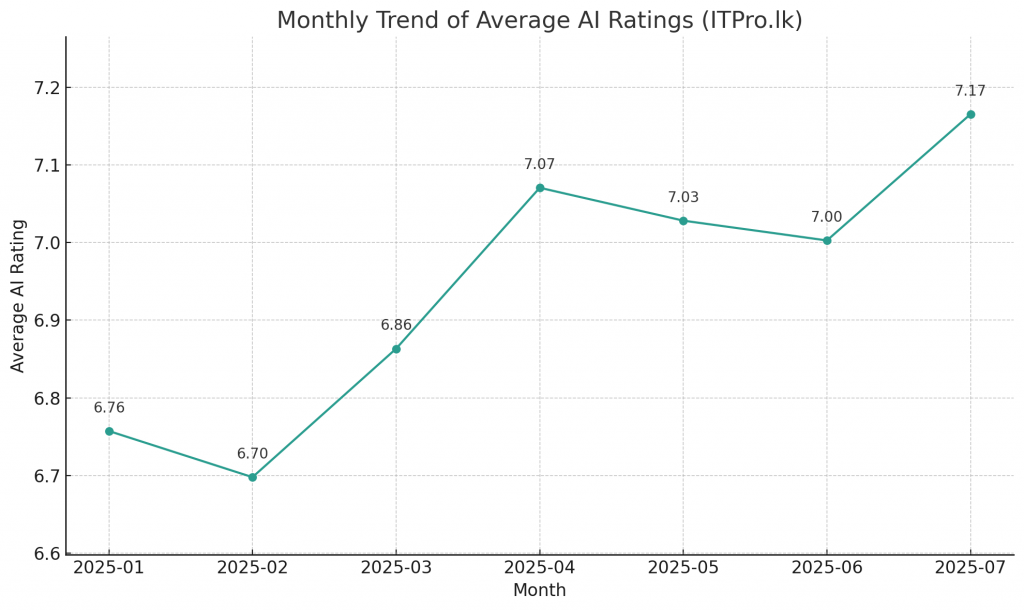
Here’s the chart showing the monthly trend of average AI ratings from January to July 2025. You can observe a general upward trend, with July 2025 having the highest average rating so far.

User Feedback So Far

We measure feature adoption using standard analytics, page hits, dashboard usage, and feature interactions. Based on current data, usage is moderate. Recruiters are exploring the AI feature, but the core value of ITPro remains in giving your job ads wide visibility, not necessarily in AI-driven automation.

Are There Downsides?

We’ve noticed a subtle trend: some candidates are now focusing more on polishing their CVs to align with AI evaluations, sometimes at the expense of actually improving their skills. (Related post: Polishing Your CV, is Really a Solution?)

We’re not making conclusions yet. We just observing. The full impact of AI in recruitment is still unfolding.

Final Thoughts

AI can support recruitment, but it shouldn’t define it. Even with all the algorithms, automation, and analytics, gut feeling and human intuition though imperfect, still play a powerful role in hiring decisions. It’s that blend of data and human judgment that creates meaningful outcomes.

The Dual Challenge of Skills and Jobs in Sri Lanka’s IT Sector

Many countries are facing two major problems:

  1. Not enough skilled people for skilled jobs (Supply).
  2. Not enough skilled jobs for skilled people (Demand).

Which do you think is the bigger problem in Sri Lanka?

This is a question we asked our users a few months back. We received different answers. Some said the problem is a lack of skilled people, while others said it’s a lack of skilled jobs. Some even said we have both problems simultaneously.

Personally, I believe both problems exist in Sri Lanka at the time of writing this. Narrowing this question down to the IT industry, there is a significant challenge in finding skilled jobs for entry-level job seekers and a challenge in finding qualified workers for senior-level positions.

Why These Problems Exist?

Growth in the Academic Sector

The growth in the academic sector, both public and private, has led to a significant increase in the number of IT graduates. Universities and technical institutes are producing a large number of graduates each year. However, the market is not expanding at the same rate to absorb these fresh graduates. This imbalance results in a surplus of entry-level job seekers struggling to find appropriate positions.

Impact of COVID-19 and the Global Economic Crisis

The COVID-19 pandemic and the resulting global economic crisis have significantly slowed down the growth of the IT industry. Many companies have had to cut back on hiring and even lay off employees. The uncertain economic environment has also led to fewer opportunities for fresh graduates, further exacerbating the mismatch between the supply of skilled workers and the demand for skilled jobs.

Experienced Professionals Leaving the Country

Another critical issue is the brain drain. Many experienced professionals are leaving Sri Lanka for better opportunities abroad. This exit of talent leaves a gap in senior-level positions that are hard to fill. The lack of experienced mentors and leaders within the country also hampers the growth and development of junior employees.

Moving Forward

Entrepreneurs are key to solving these problems and taking advantage of opportunities in the IT sector. They can create jobs, drive innovation, and build strong networks to support the industry. By offering good salaries, career growth opportunities, and remote work options, they can attract and keep top talent, reducing the loss of skilled workers to other countries. Despite these challenges, there is always hope.

Do you have anything in your mind? Feel free to share in the comments section, and let’s discuss!